|
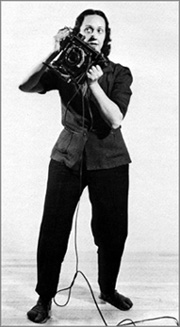
Barbara
Morgan (1900-1992)
"Searching Out Ways to Communicate
the Intensities of Life"
Pinch-hitting
for Stephanie on this issue’s Before You, we take a look
at the work of Barbara Morgan. Morgan’s 4x5 Speed Graphic
images provide an intimate look into the subjects that meant
the most to her, particularly her interest in Martha Graham
and her dance company. Her work will speak for itself, and
her legacy and beautiful use of light will long
be remembered.
--
Candice C. Cusic
Chicago Tribune staff photographer
As an
art major at the University of California at Los Angeles in
1919, Barbara Morgan longed to be a painter. In 1925, she
married freelance writer/philosopher Willard Morgan, who introduced
her to photography, even talking her into wearing a Leica
around her neck so she could “shoot the unexpected.”(Mitchell)
Morgan was initially skeptical of photography, “If you
just click the shutter, you are stealing reality! I can’t
be a thief. I must create.” (Aperture)
After
giving birth to her second son in 1935, Barbara realized how
painting consumed her. “I lost track of everything else.
I knew that I must be a mother first, and therefore I wouldn’t
have time to paint.” When Morgan confided her fears to
her husband, he encouraged her towards photography, helped
her build a darkroom, and took care of their children at night
while she worked. (Mitchell)
Morgan
saw a performance by choreographer Martha Graham in 1935 and
challenged herself to capture Graham’s movements in photographs.
“Every photographer has his own methods of personal expression.
My way is to allow the unconscious to do a large share of
the work. First, I watch rehearsals and performances in complete
detachment... without trying to plan pictures. Next I let
these impressions “soak in” over as long a period
as possible...I like to photograph only when I have had time
to digest the subject and assimilate it with all I know and
feel.” (Morgan)
“When
I became a photographer emotionally and practically, the only
way I could feel honest about photographing seriously was
to photograph with imagination, rather than recording, for if I merely echoed
the obvious, I would lose my creative integrity. Therefore,
I began with photomontage, knowing it could only come from creative imagination.
|
In 1935, after I had accepted my validity as a photographer
via photomontage, I still had the urge to be a good mother,
for we adored our children and they came first. How could I
coordinate all these complexities? I finally developed a three-channel
system so I could have multiple concepts in mind simultaneously
(like a three-way montage). Channel one was my family- getting
meals and taking care of the boys; channel two was my creative
work; and channel three was my community responsibility.”
(Mitchell)
“I’m
not just a ‘Photographer’ or ‘Painter,’
but a visually aware human being searching out ways to communicate
the intensities of life.” (Aperture)
Morgan’s 70-year career includes her involvement as a
founding member of Aperture and the publication of several
photography books including
“Martha Graham: Sixteen Dances in Photographs,”
and “Summer’s Children: A Photographic Cycle of
Life at Camp.”
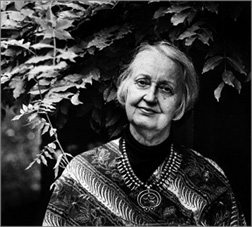
“I
don’t think too much about old age. I get a kick out
of the fact that I was born in 1900, but I don't take age
too seriously... I want to work as long as I can. My hope
is that photography will contribute to global harmony.”(Mitchell)
Patnaik,
Deba P. “Barbara Morgan: Masters of Photography.”
Aperture
Morgan,
Barbara. Photographing the Dance. New York: Morgan & Lester:
Graphic Graflex Photography, 1947.
Mitchell,
Margaretta K. Recollections: Ten Women in Photography. New
York: Viking Press, 1979.
Special
thanks to Lloyd Morgan and the Willard & Barbara Morgan
Archives. Please visit the UCR/California Museum of Photography's
Barbara
Morgan exhibit, part of their Women Photographers series.
|